
Crop yield in young temperate alley cropping systems is affected by tree height, distance to trees and crop type, while impacts on crop quality remain limited
Vanneste, T., De Praetere, L., Pardon, P. et al. CARAT: an innovative tool for quantifying carbon sequestration in agroforestry systems. Agroforest Syst 99, 68 (2025). httpsPardon, P., Quataert, P., Bracke, J. et al. Crop yield in young temperate alley cropping systems is affected by tree height, distance to trees and crop type, while impacts on crop quality remain limited. Agroforest Syst 99, 162 (2025). https://doi.org/10.1007/s10457-025-01260-2://doi.org/10.1007/s10457-025-01162-3 Abstract One of the premises of temperate agroforestry is the potential to (at least partly) compensate for the impact on arable crop yield through the production of marketable goods by the tree component (e.g. fruits, nuts, timber), whilst enhancing ecosystem service delivery…
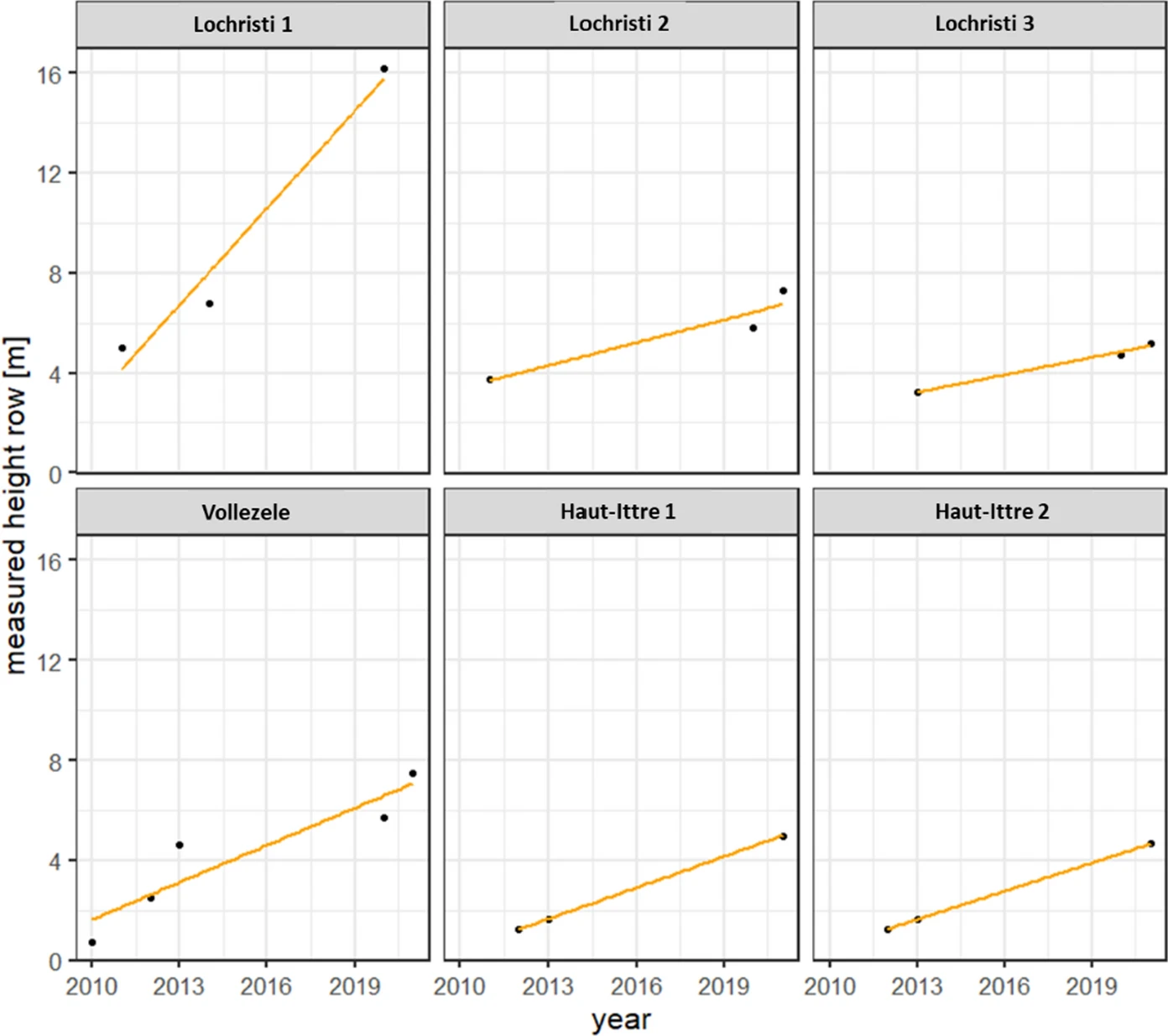
Vanneste, T., De Praetere, L., Pardon, P. et al. CARAT: an innovative tool for quantifying carbon sequestration in agroforestry systems. Agroforest Syst 99, 68 (2025). httpsPardon, P., Quataert, P., Bracke, J. et al. Crop yield in young temperate alley cropping systems is affected by tree height, distance to trees and crop type, while impacts on crop quality remain limited. Agroforest Syst 99, 162 (2025). https://doi.org/10.1007/s10457-025-01260-2://doi.org/10.1007/s10457-025-01162-3
Abstract
One of the premises of temperate agroforestry is the potential to (at least partly) compensate for the impact on arable crop yield through the production of marketable goods by the tree component (e.g. fruits, nuts, timber), whilst enhancing ecosystem service delivery and increasing diversity and resilience of the agricultural system. However, substantial production of marketable goods by the woody component does not occur in the first years after tree establishment. Hence, estimation of the impact on crop yield and quality during this initial lag phase is key to assess the economical viability of foreseen agroforestry implementations. At present, estimates of impact on crop yield are mostly based on modelling while a lack of experimental data remains. Therefore, in this study, yield and quality of five main arable crops (maize, potato, winter cereals) were studied during seven consecutive years in an elaborate field experiment on a set of six alley cropping fields throughout the first decade after tree establishment. For each crop, mixed models were used to express yield and quality variables as function of “H”, the ratio of distance to the trees and tree height. Decreasing yields were observed with decreasing values of H. Effects of tree presence on crop quality remain limited and/or of minor economical relevance during the first decade after tree establishment. Our findings can aid to estimate tipping points with regard to tree height and distance where beneficial or negative impacts of tree presence predominate over one another. In addition, they contribute to estimating the impact on crop yield for farmers during the first decade after tree establishment and the adequate levels of potential remuneration through financial incentives (e.g. subsidies by the government).
Read full article
https://link.springer.com/article/10.1007/s10457-025-01260-2